 |
Glenn’s Computer Museum |
| Home | New | Old Military | Later Military | Analog Stuff | IBM Stuff | S/3 Mod 6 | S/32 | Components | Encryption | Misc | B61 |
change log |
contact me |

|
Glenn’s Computer Museum |
| Home | New | Old Military | Later Military | Analog Stuff | IBM Stuff | S/3 Mod 6 | S/32 | Components | Encryption | Misc | B61 |
change log |
contact me |


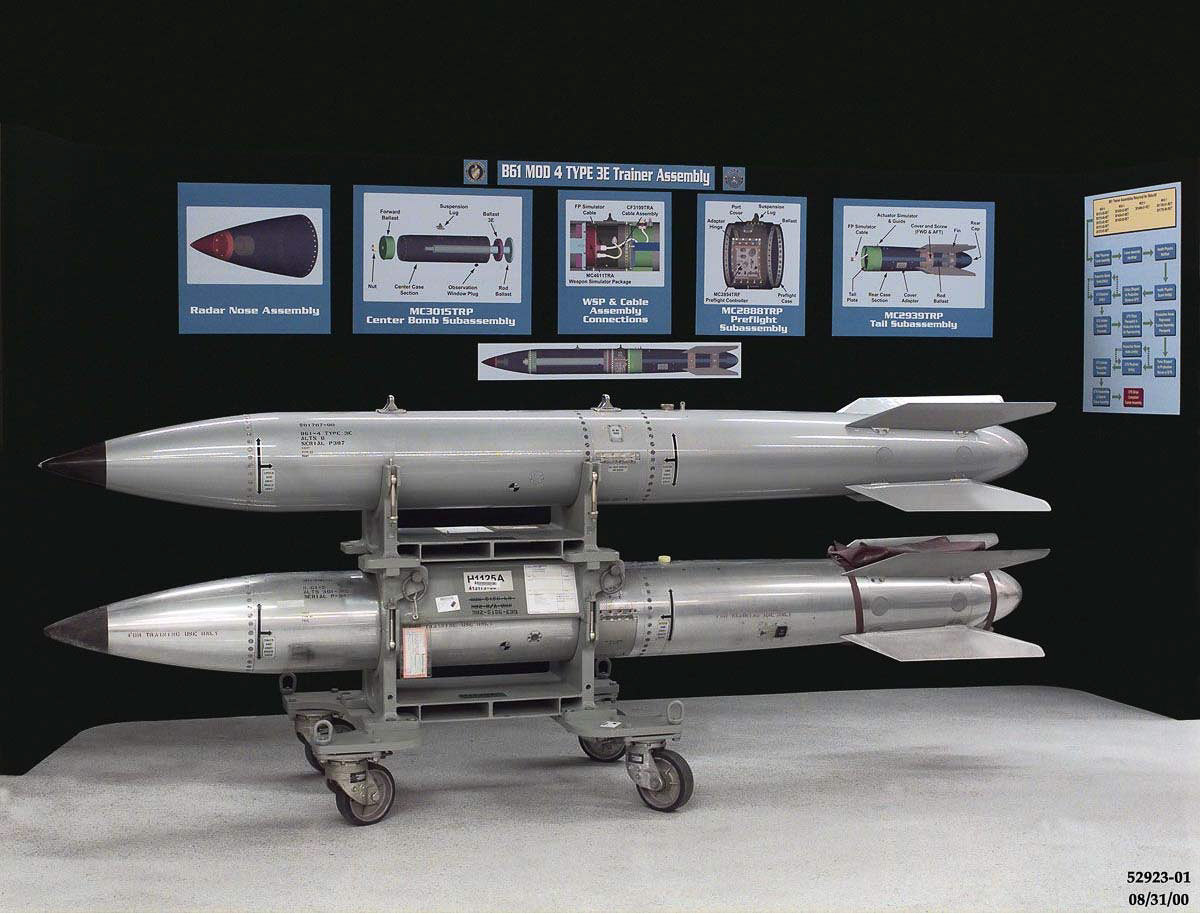







Our device (figures 1 and 9) appears to be a "preflight controller" from a B61 nuclear bomb (also here) (or, more likely, from a B61 trainer like this). There are many versions of a B61, our device probably comes from one of the tactical versions (Mods 3, 4, or 10). The B61 family is the best documented of all modern U.S. nuclear weapons and there is much information on the web; I recommend further online reading.
The preflight controller lives in the third of the four major bomb segments. Figure 2 is a low-resolution picture (from other sources)of a B61 bomb somewhat disassembled (the nuclear explosive component is not disassembled). The preflight controller is in the middle segment and has its access flap opened in this picture. The controller allows preflight setting of things like fuzing options and functions related to "use control" of the weapon. It interfaces with the aircraft's AMAC (Aircraft Monitoring and Control) system and connects to the bomb's arming and firing mechansisms.
Before I describe the component in more detail, I need to talk about its provenance, or, how do I know it's a preflight controller from a B61 bomb or B61 training device? The person I got this from had mislabeled it as a part from an A-6 Intruder fighter-bomber. And the "demil" label also has "A-6" written on it. But, it is a B61 preflight controller; here's my evidence...
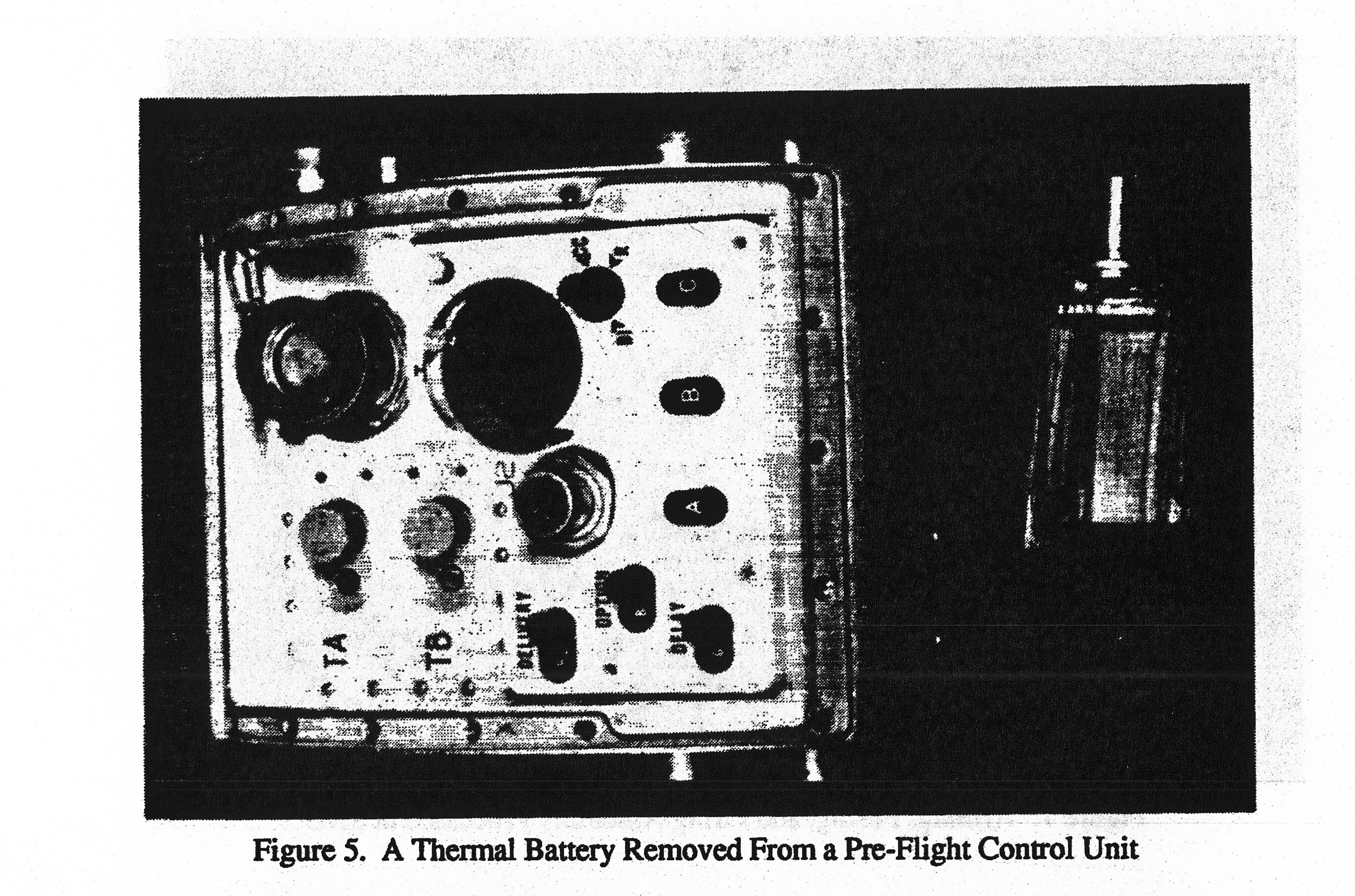
One critical reference that I have is Interim Development Report for the B61-6,8 Bombs, Sandia report SAND88-2986 (redacted). Here are the three (heavily redacted) pages (figures 3, 4 & 5) describing the Mod-6,8 preflight controller (MC4136) and one page describing the "command disable" controls on the controller. The controls described and shown in SAND88-2986 are very similar to our device (the MC4136 has a "mission" switch which ours doesn't, and ours has a separate "strike enable plug" socket). Furthermore the command disable mechanism (interaction of the three code switches, the option switch to set "DI", and the T pullout handle) is described precisely, and our device behaves exactly the same way. The position of the controls shown. however, is slightly different than ours, but a layout difference is reasonable since there are several versions of the B61, each with slightly different controllers.
Figure 6 is a page from Recovery and Recycling of Aluminum, Copper, and Precious Metals from Dismantled Weapon Components, SAND94-2759 and shows of a B61 preflight controller case. The controls in this picture are positioned exactly the same as in our specimen. A further hazy confirmation is found in this very low resolution picture of a B61 training device (figure 7). The diagram on the wall shows a control panel with connections to the front of the bomb looking similar to ours. And, of course, the center section of the previously shown disassembled B61 picture looks like our control panel. Another subtle clue is that the only component visible without taking the tightly sealed controller apart is labeled MC2865. The "MC" designation is used by Sandia for weapon components.
Another obvious question is why is there a preflight control panel on the bomb itself, doesn't the aircraft control all these settings? Yes, and no. New aircraft such as the B-2 bomber have an advanced AMAC (Aircraft Monitoring and Control) system (based on MIL-STD_1760 which can control the various bomb options (including setting the PAL unlock code). Older aircraft such as the A-6 Intruder had more primitive AMAC systems that could not control may of the bomb options from the aircraft.
So, based on SAND88-2886 and other sources, what does the preflight controller control? The two-digit switches labeled TA and TB specify two "safe separation" times in seconds. This defines the time that must elapse after the bomb is released from the aircraft before detonation can occur. (The actual arming process starts a few seconds before this time, but detonation cannot occur before this time). Our switches are hard-wired to start at 10 seconds. The choice between the two specified separation times is done via aircraft control.
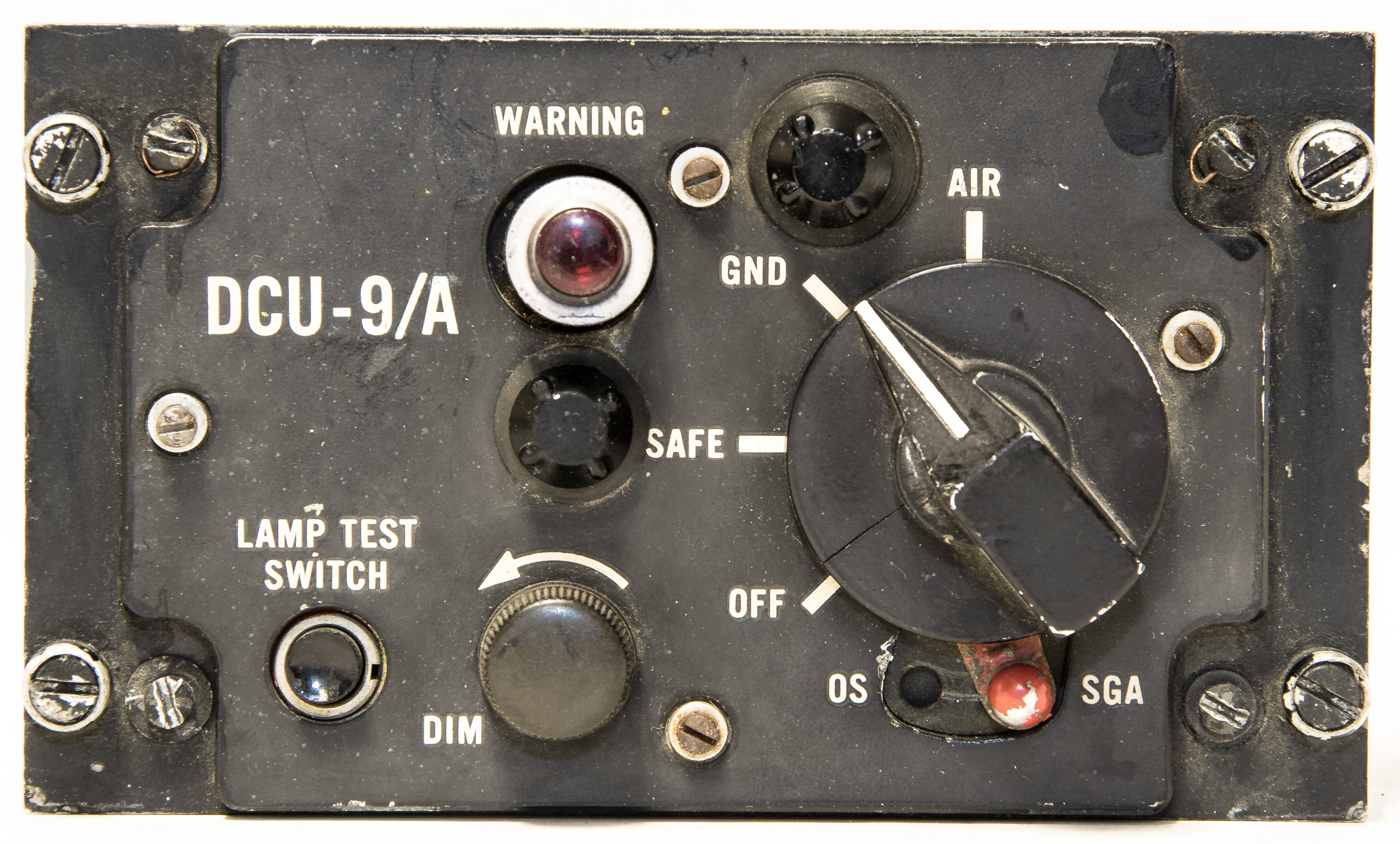
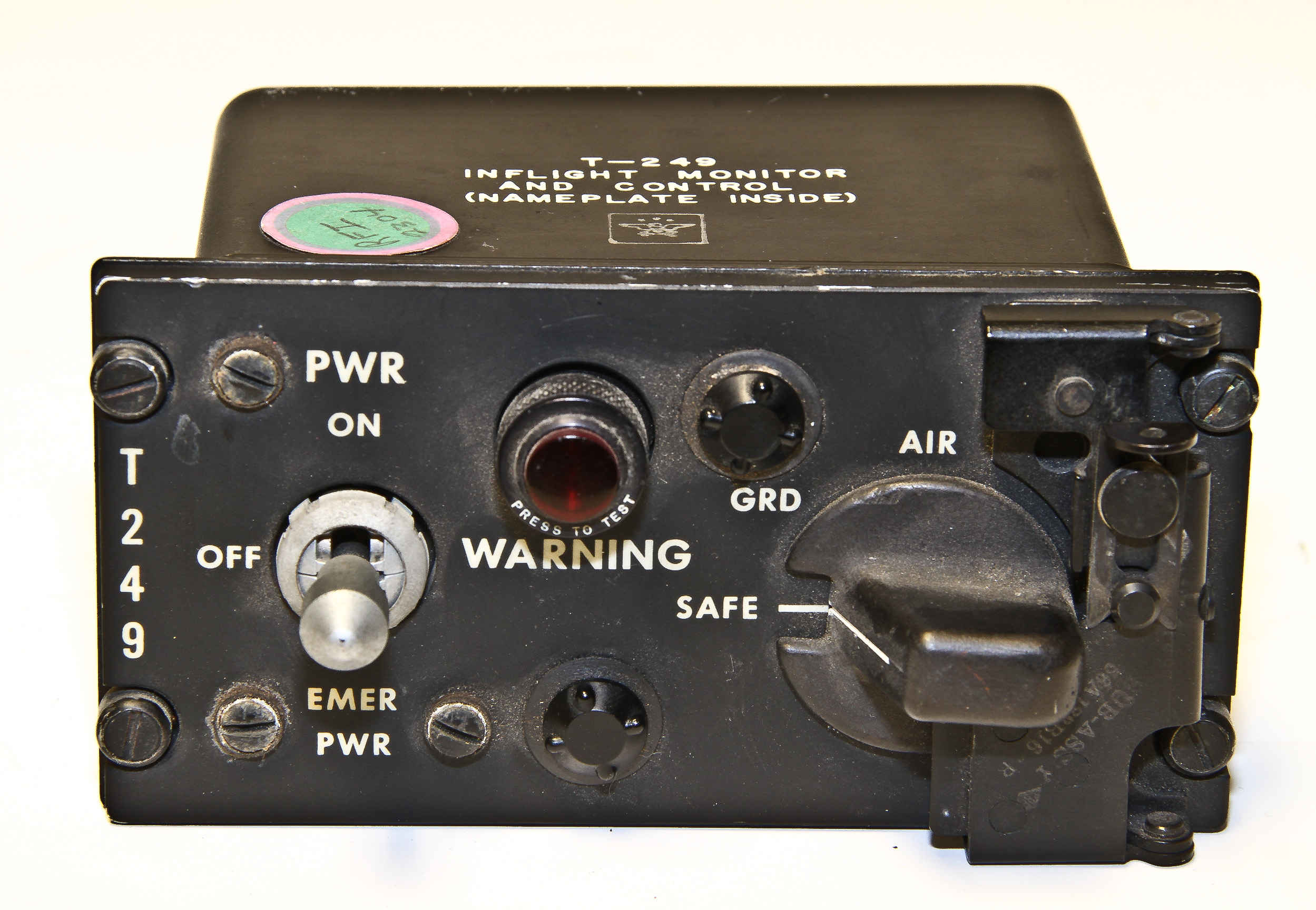
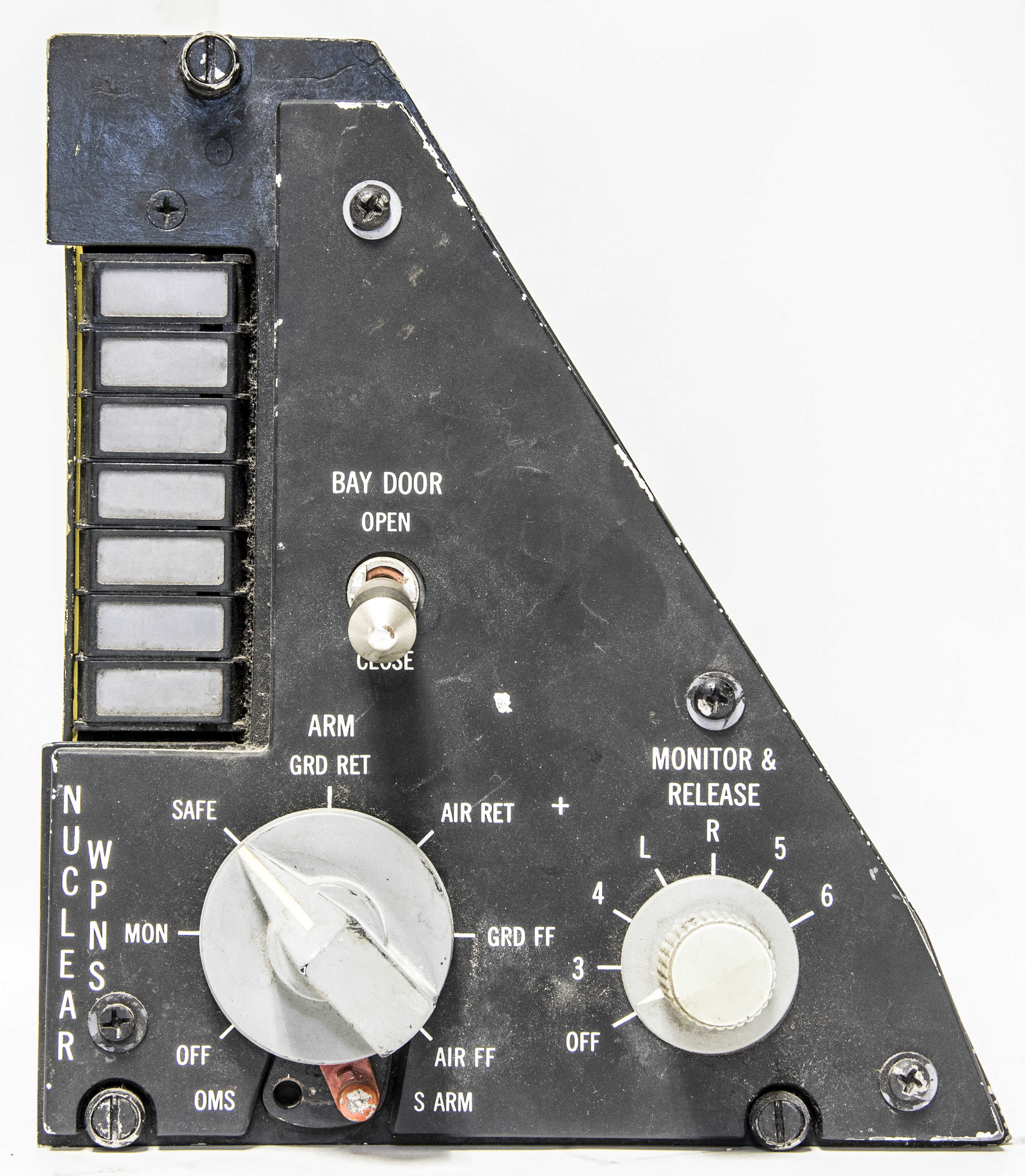
The switch labeled delivery specifies one of two options for the fall of the bomb: FF (freefall) or RE (parachute retarded). (The choice of fuzing--airburst or groundburst--is usually is specified by the AMAC. For example, Figure 8A shows our T-249 switch from a 1960's B-52 bomber, and Figure 8B is the similar DCU-9/A also used on B-52 bombers. Figure 8C is the more complicated nuclear weapon control switch from the F-111 bomber.
These switches control air burst vs. ground detonation, and the F-111 controls free-fall vs. parachute retarded fall.) Some models of the B61 have an additional delivery option of "laydown". This is like parachute-retarded groundburst except that detonation is delayed for some period of time after contact. This provides time for a low-flying delivery aircraft to avoid being destroyed by the detonation. Figure 9 shows another element of the aircraft control system: an "nuclear consent" switch from an F-16 fighter.
The delay switch control the delay between separation and deployment of the parachute (in the case of retarded fall. The options we have are G (0.3 s deployment delay), H (0.6s delay), and J (1.6s delay). In the case of a laydown delivery, this switch also controls the delayed detonation time.
The function of the switch labeled option is redacted from my copy of the B61-7,8 report. A reasonable guess is that the option switch controls the yield; most B61 versions have multiple selectable nuclear yields. The details of variable yield are heavily classified, but reputable sources claim that the four yields options are possible with most versions. Our option switch has 6 settings: A-F.
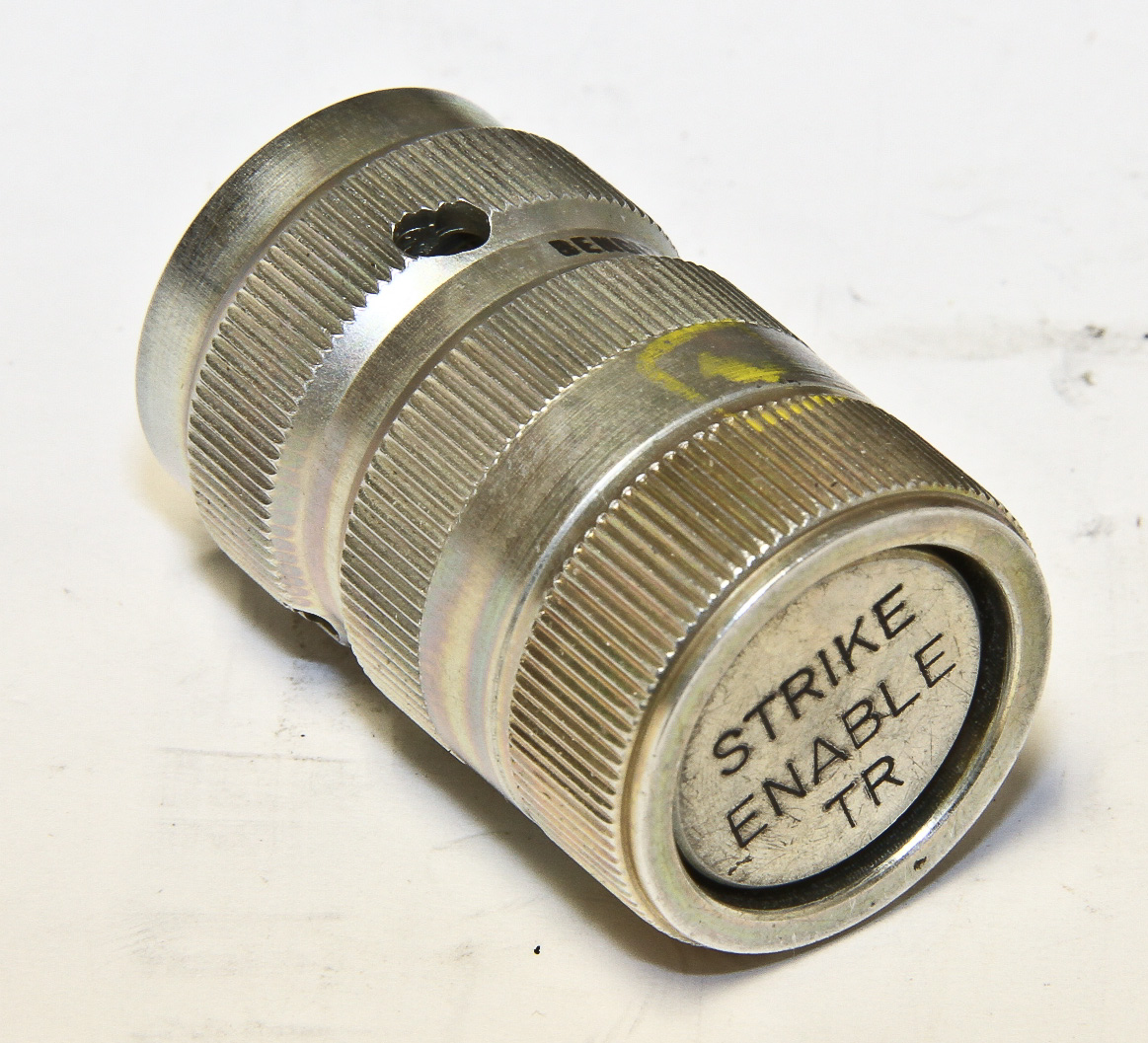
The MC4142 "strike enable plug" (figure 12) is just that: this plug must be inserted to complete critical circuits in the arming and firing mechanisms. In particular, the plug completes "IUQS" signal and nuclear identification signal from the AMAC connection. (The IUQS is a multi-pulse encoded signal necessary to open a critical switch in the arming and firing system. This involves some very interesting concepts that are publically documented; I recommend further reading.) Our plug has a "tr" on it, perhaps futher indicating that it's from a training device.
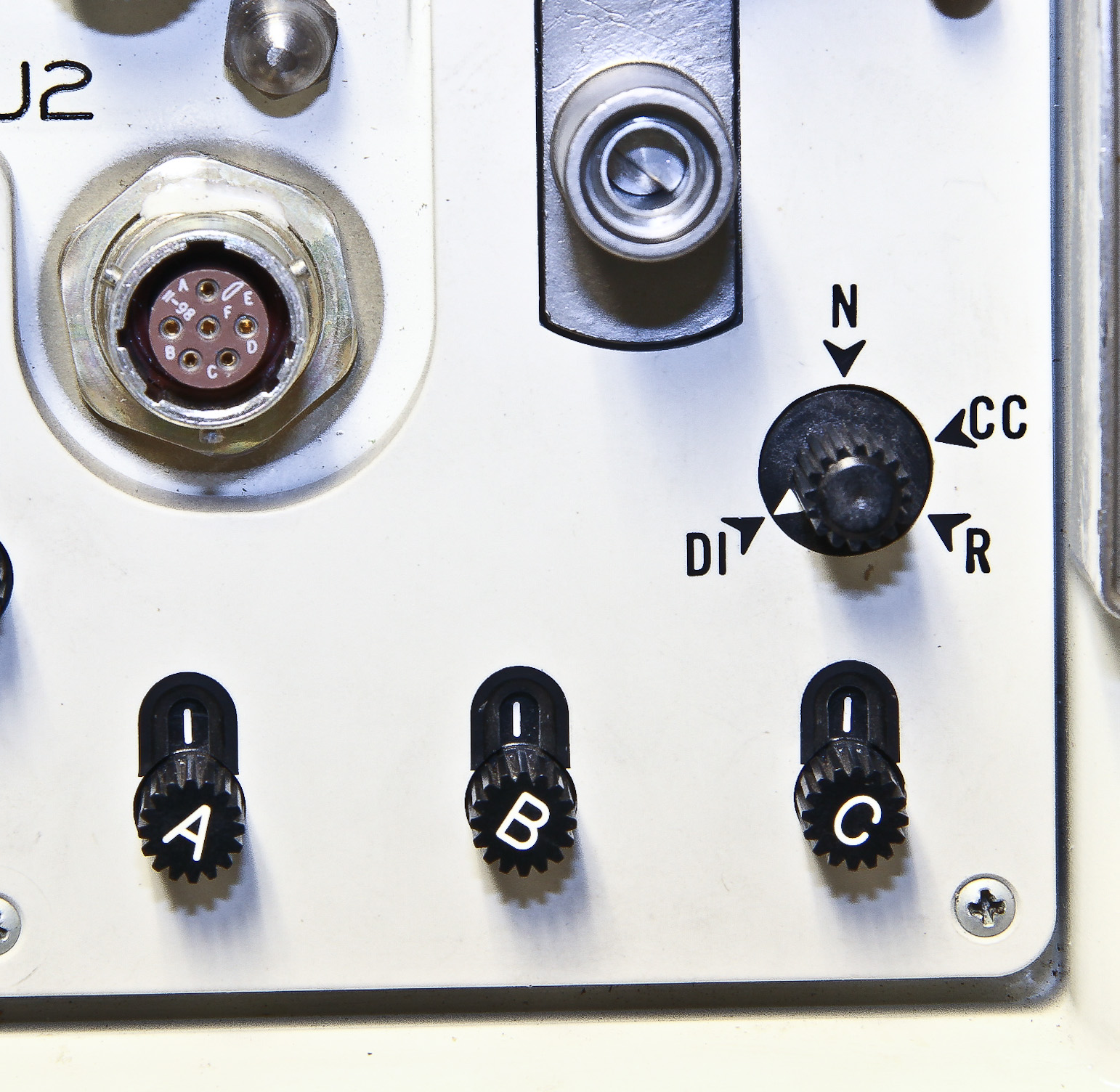
The three numeric switches at the bottom, together with the swich right above them and the T-handle are used to initiate "command disable". This option will perform a "non-violent" function within the nuclear explosive component that disables the device from being able to detonate. This disablement can only be undone at the bomb assembly facility. The existance of a command disable function is publically documented, but the details of how it functions are highly classified. An obvious hypothesis is that disablement is caused by a unreversable switch (possibly an explosive switch) severing the bomb's power input. Another likely possibility is that a small explosive charge destroys critical triggering components. The mechanism must be inside the sealed exclusion region of the bomb or else it could be undone easily.
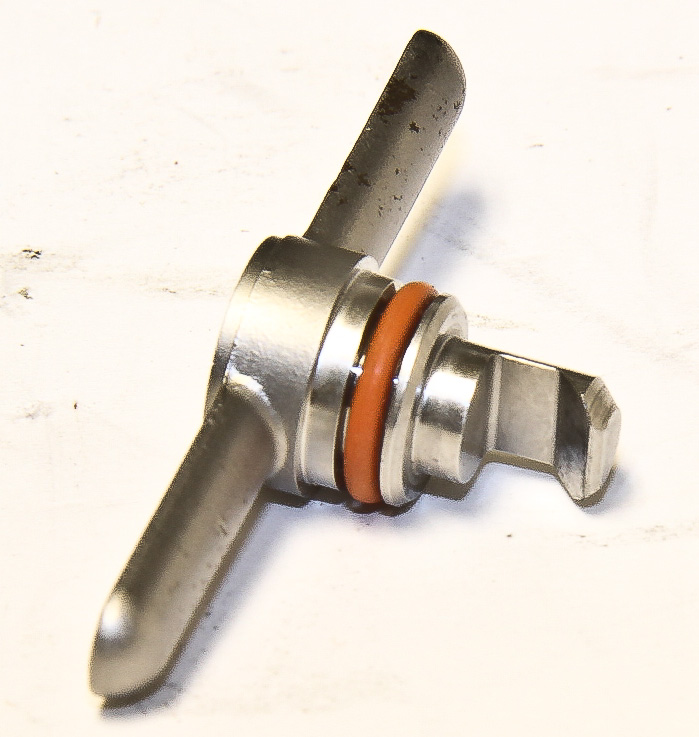
To initiate the command disable function, the appropriate code is set in the three code wheels. In our device, the code is 1-1-1 (there is an exact sequence that must be followed of resetting the code to 0 and then setting 1-1-1). Then an interlock on the above four-position switch is released and it can be turned from "N" (normal or nuclear, I guess) to "DI" (disable). Then an interlock on the T-handle is released and it can be removed. Removing the T-handle (figure 11) pulls out and releases a plunger which hits the primer of a MC4246A thermal battery. This battery directly provides power to the disablement function. As expected, our device has no battery installed.
Note that there are two more options on the N/DI switch: "CC" and "R". I have no documentation as to what these two other function are but a good guess as to R is "render safe procedure" which returns bomb to a safe (e.g., before pre-arming) condition. CC is likely used for changing the 3-digit code. It can be selected using the same 1-1-1 code, but setting CC appears to lock the code wheels.
Finally, there is the PAL (Permissive Action Link) conector socket shown in figure 13 (the J1 socket). The PAL mechanism is a coded lock within the nuclear explosive region that prevents unauthorized arming and detonation. The details of how it works are highly classified, but a good general description of the history and the concepts are found here and here. (This is a massively interesting concept; I recommend further reading.)
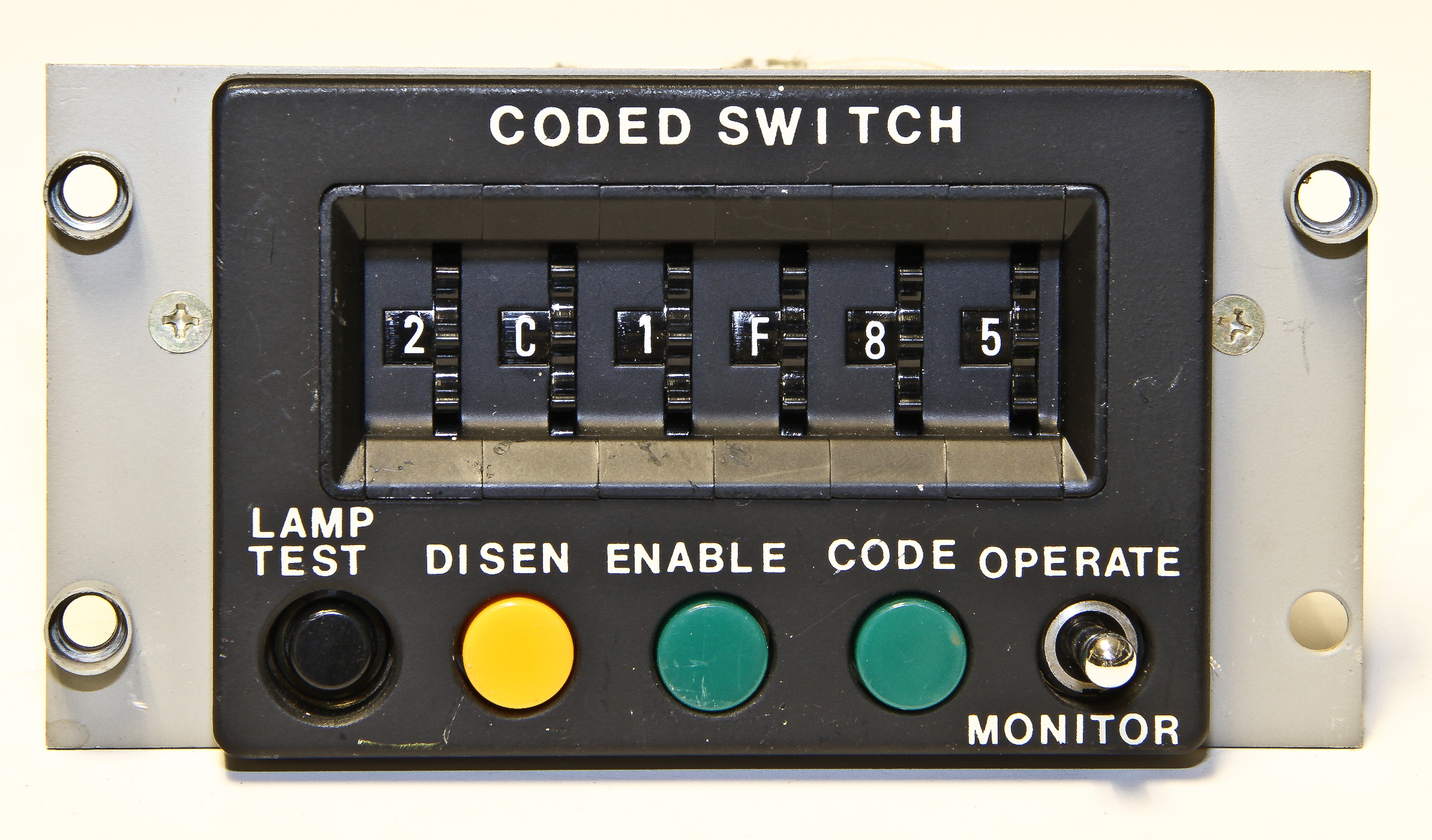
For the B61 family, depending on the aircraft type, the PAL unlock code can be entered either from the AMAC system in aircraft (using a coded switch similar to the one shown in figure 16) or pre-flight via the J1 PAL socket on the preflight controller using an external code-entry device such as the one shown in figure 17 (picture is from SAND88-2986). (The switch is Figure 16 is not an actual nuclear coded switch, but it is very similar--see the sidebar below). Some aircraft, such as the original B-1B bomber, do not have the AMAC wiring to support PAL operations and instead use a coded switch as part of the pre-arming process to a weapon whose PAL has been unlocked on the ground--see the coded switch sidebar below.
In addition to unlocking the weapon, a PAL controller can also change the unlock code as well as setting the device into a maintenace mode. In this mode the sealed "exclusion region" can be opened without triggering the "active protection" mechanism. This is a highly classified mechanism that is present in some nuclear weapons which "senses attempts to gain unauthorized access to critical weapon components, and responds by initiating weapon disablement." (from PAL Control of Theater Nuclear Weapons, SAND82-2436).
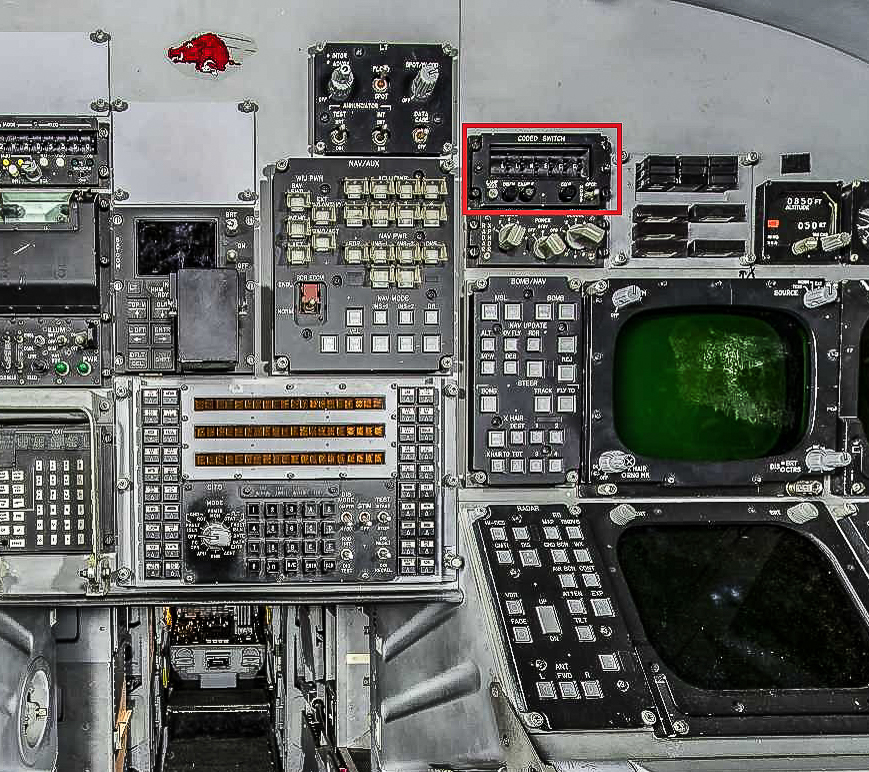
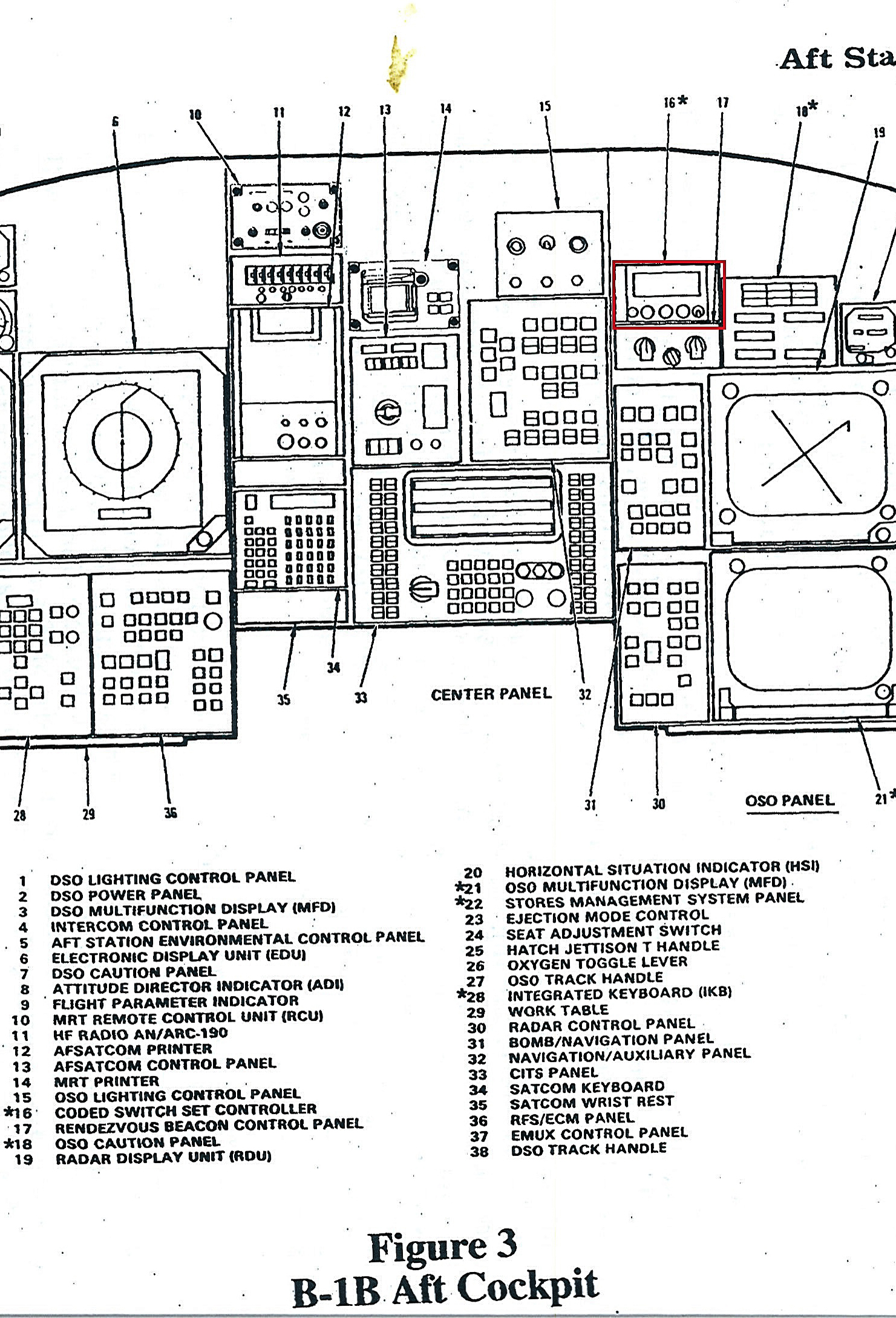
Figure 16 is not a real military coded switch, but it sure seems similar. Figure 17A is a photo of a portion of the aft cockpit of an early B-1B bomber with the real coded switch highlighted. Figure 17B is a photo of a person using the same aft cockpit. The highlighted coded switch is at an angle. Figure 17C is a portion of the B-1B aft cockpit diagram with the position of the coded switch highlited. Note that the similarity of the simple drawing and the pictures to our switch: four button/light shapes to left of a switch, with six selectiable hex switches above.
(Also, a closeup of Figure 17A seems to show that it is using a strange military hexadecimal notation where E, J, L, M, P, and R are used instead of A, B, C, D, E, and F.)
The early B-1B is an example of a aircraft that does not use an aircraft-controlled PAL mechanism. Instead, the coded switch is part of the arming path to a weapon whose PAL has been unlocked on the ground. Note that modern B-1B bombers no longer have support for nuclear weapons.